During 36 months of project implementation, protocols for testing of materials, single cells and
stacks were defined, published and shared with other CleanH2 projects. In-situ and ex-situ tests to
parametrize degradation models were defined and performed. They include HD load cycles and
specific stressors with focus on voltage cycling, temperature and relative humidity. A multiscale
modelling approach was developed which describes cell performance and degradation processes
from mesoscale up to single cell. Mesoscale models of the cathode catalyst layer (CL) have been
developed to consider local degradation of the carbon support and the platinum catalyst. The micro
kinetics of the oxygen reduction reaction, carbon corrosion, and hydrogen peroxide formation are
accounted. Moreover, a microstructure-resolved model of the CL degradation due to Ostwald
ripening has been developed to link material properties of the CL with degradation rate. A
continuum-scale CL degradation model was implemented to simulate the degradation-related
change in Pt particle size distribution and the associated change in electrochemical surface area.
Additionally, the dynamics of chemical membrane degradation was studied involving radical attack.
These degradation models have been coupled with the continuum-scale performance models to
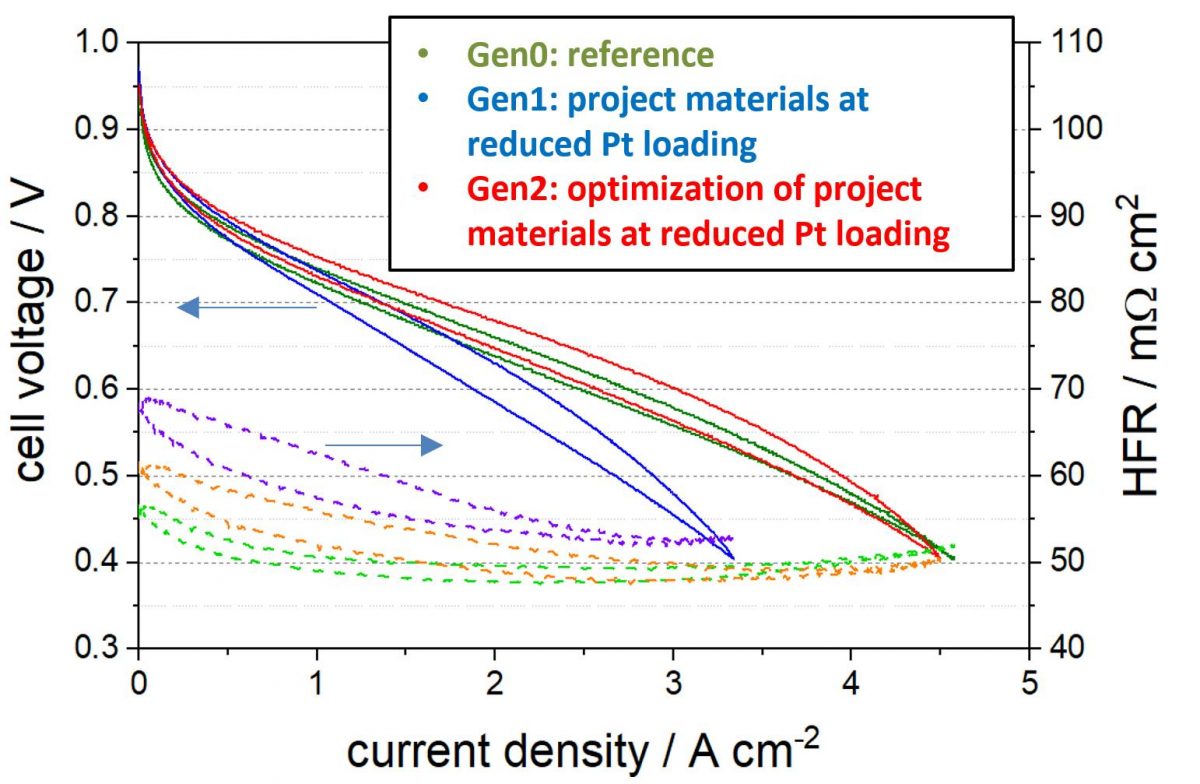
simulate performance loss and impacts of different stressors. As reference a commercial MEA from
IRD was used to realize durability tests up to 1,500 h using the developed PEMTATIC HD-load cycle
along with in-situ characterization protocols and ex-situ material analyses. To develop heavy duty
tailored MEAs, innovative materials from IMERYS, Heraeus and FCMC/Chemours were used to design
the first generation of project MEAs (Gen1 MEA) at reduced Pt loading. As next step, Gen2 MEA with
improved materials was designed which shows similar performance as Gen0, but at significantly
lower Pt loading. Based on extensive electrochemical characterisations throughout the durability
tests, extensive ex-situ analyses at the beginning and end of test (e.g. FIB-SEM, AFM, 3D-TEM) as well
as outcomes from degradation models, first conclusions on the design of materials and components
for Gen3 MEA were drawn. Specifically, modifications are foreseen to Pt stability as well to CL
formulation. Additional model-based input will be used for final selections of best options for Gen3
MEA and will provide perspective for possible modification beyond end of the project.
Communication and dissemination actions include 26 conference/workshop contributions,
presentation at 7 fairs/exhibits and regular communication on LinkedIN (>300 followers).