3rd year of project implementation completed

During 36 months of project implementation, protocols for testing of materials, single cells andstacks were defined, published and shared with other CleanH2 projects. In-situ and ex-situ tests toparametrize degradation models were defined and performed. They include HD load cycles andspecific stressors with focus on voltage cycling, temperature and relative humidity. A multiscalemodelling approach was developed

3rd year of project implementation completed Read More »

Review of the first project period

During the first period, protocols for testing of materials as well as single cells and stacks were defined. They are available as a public report and have been shared with other CleanH2 projects related to MEA or stack development. In-situ and ex-situ tests to parametrize degradation models were extensively discussed between modelers and experimentalists. A

Review of the first project period Read More »

First year of project implementation

During the first project year (02/2023-01/2024), significant work was carried out. Firstly, the partners defined operation protocols for testing of materials (WP2) as well as for testing of single cells and short stack (WP4). In this context inputs from WP1 on relevant HD load cycles were provided and analyzed. The PEMTASTIC testing protocols and conditions

First year of project implementation Read More »

Draft report on FC testing protocols available

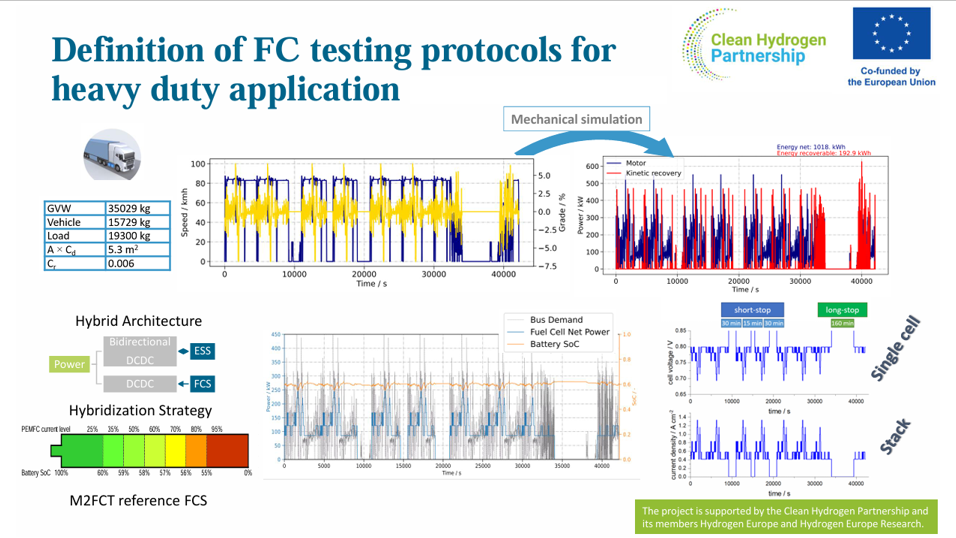
In PEMTASTIC fuel cell cell testing protocols for heavy-duty applications have been defined. A public report is available and will be uploaded on the project website soon. The protocols and the defined HD load profile enable performance and durability investigation of MEA using representative conditions for long-haul applications. The conditions are defined for PEMFC stacks

Draft report on FC testing protocols available Read More »

PEMTASTIC results presented at EFCF 2023 in Luzern

In this work, power requirements in Long-haul HDV were derived from several representative driving cycles obtained from different sources (VECTO and DriveCAT). For this purpose, a Python software tool was developed. Using the power required in the electric motor to fulfil the cycle, different PEMFCS operation and different hybridization strategies between PEMFC and ESS were

PEMTASTIC results presented at EFCF 2023 in Luzern Read More »

Scroll to Top